
October 12: Monday — Identifying True Prophets
Bible Focus
- Deuteronomy 18:20
- 1 Kings 22:1–14
- 1 Samuel 9:3–14
Summary
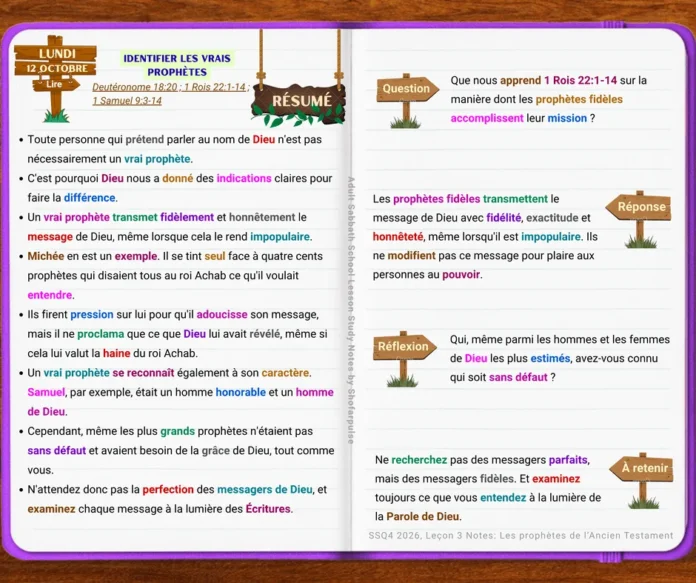
- Not everyone who claims to speak for God is a true prophet.
- So God gave us clear ways to tell the difference.
- A true prophet speaks God’s message faithfully and honestly, even when it makes them unpopular.
- An example is Micaiah, who stood alone against four hundred prophets, all telling King Ahab only what he wanted to hear.
- They pressured him to soften his message, but he spoke only what God told him, even though it made King Ahab hate him.
- A true prophet is also known by their character, for Samuel was an honorable man and a man of God.
- But even the greatest prophets were not flawless, and they needed grace just like you.
- So do not expect perfection from God’s messengers, and test every message by Scripture.
Understanding Identifying True Prophets
- Identifying true prophets requires examining whether their messages agree with God’s Word and whether they faithfully communicate what God has revealed.
- Micaiah’s example shows that a true prophet does not change God’s message to please people in power, even when speaking the truth brings opposition.
- The lives and character of God’s messengers also matter.
- However, prophets are human and are not flawless.
- This lesson reminds us to value faithfulness over perfection and to test every message against Scripture.
Question
- What does 1 Kings 22:1–14 tell us about how faithful prophets operate?
Answer
- Faithful prophets speak God’s message faithfully, accurately, and honestly, even when it is unpopular. They do not change the message to please people in power.
Reflection
- Who, even among the most esteemed men and women of God, have you known to be flawless?
Takeaway
- Do not look for perfect messengers. Look for faithful ones. And always test what you hear by God’s Word.
Continue Studying
For more Sabbath School lesson notes, explore: